
AfriHack 2026: Two Cities, Young Builders, and the Solutions That Got Them Noticed

Empiras Global's flagship student hackathon series wrapped its biggest year yet, and this time, the work didn't end when the trophies were handed out.

AfriHack 2026. Two weekends. Two cities. University, TVET college, and digital skills programme students from across South Africa spending three days each doing what AfriHack was built for: building real technology, presenting it to real people, and leaving with something that actually changes their trajectory.
Johannesburg ran from 4 to 6 September. Cape Town followed from 18 to 20 September. Both events opened with a Corporate Day that brought students into the same room as the people who hire, fund, and build in South Africa's digital economy, followed by a 24-hour hackathon where those students showed exactly why they deserved to be there.
Johannesburg: Where It Started
The Johannesburg leg opened with over 100 young people filling the venue for Corporate Day. Opening remarks came from representatives from our sponsors and partners: GIZ Commission Manager Dr Suraya Adams, Princess Mashamahite, Corporate Planner & Strategy Coordinator of Automotive Industry Transformation Fund, and Qiniso Ntuli, Managing Director of 4OnPritchard.
Two panels followed. The first, moderated by Lungile Lulu Ntuli (Empiras Global), featured Reuben Honigwachs (Google Cloud), Nelisiwe Ntsibande (22 ON SLOANE), Oratile Molokane (Tsimologong Precinct), and Tendai Mazhude (mLab) on what industry actually needs from tech youth. The second brought entrepreneurs to the stage: Naidene Knife (Nyami Nyami), Thoko Miya (TooMuchWifi), and Edzai Zvobwo (Acalytica), moderated by Neeresh Rohitall (CAPACITI), exploring what it takes to build a business in the era of AI., mode


The Embassy of Japan in Pretoria, represented by Ryan Keet, Cultural Assistant, presented the MEXT scholarship and JET programmes to an audience that, for many, was hearing about these international pathways for the first time.
Then came the mock interviews. Participants sat across the table from talent acquisition managers and got direct, unfiltered feedback on how they present, how they answer, and what they need to sharpen. For students who have never stepped inside a corporate building, that experience alone was worth showing up for.
The hackathon that followed was 24 hours of building under pressure. When it was over, the judges named their top three:
1st Place: Stacked Minds (Regent Business School, University of Johannesburg, CAPACITI) — an all-female team who took the top spot in a field full of strong competitors.
2nd Place: Africanise It (WeThinkCode)
3rd Place: Git Happens (STADIO Higher Education)

Cape Town: Where the Judges Couldn't Decide
Cape Town brought its own energy from the very first session. Alderman James Vos, Mayoral Committee Member for Economic Growth at the City of Cape Town, delivered a keynote that set the tone for the day: what the digital economy needs from this generation, and why the city is paying attention.
Two panels followed. The first, moderated by Chesarae Pillay of CAPACITI, featured Aphiwe Mkhwanazi (Amazon), Crosby Hunda (WeThinkCode_), and Aviwe Melford (EY) on what industry actually needs from tech youth. The second brought entrepreneurs to the stage: Josh Stapleton (Isometry), Dr Jeanne Fredericks (The Change Hub), and Lorna Mlonzi (Sky Internet), moderated by Nafisah Abrahams of NafiConsulting, exploring what it takes to build a business in the era of AI.
Fifteen teams entered the hackathon. What came out of it gave the judges a genuine problem. Josh Stapleton (Isometry), Jamie Wynaard (Loop), Luke Jeffrey (Allan Gray), Vuyani Ngabaza (Ogilvy), and Marcus Rance (Quantum Leap Consulting) battled to separate the top teams. First and second place were separated by a single point. Third place was a dead tie.


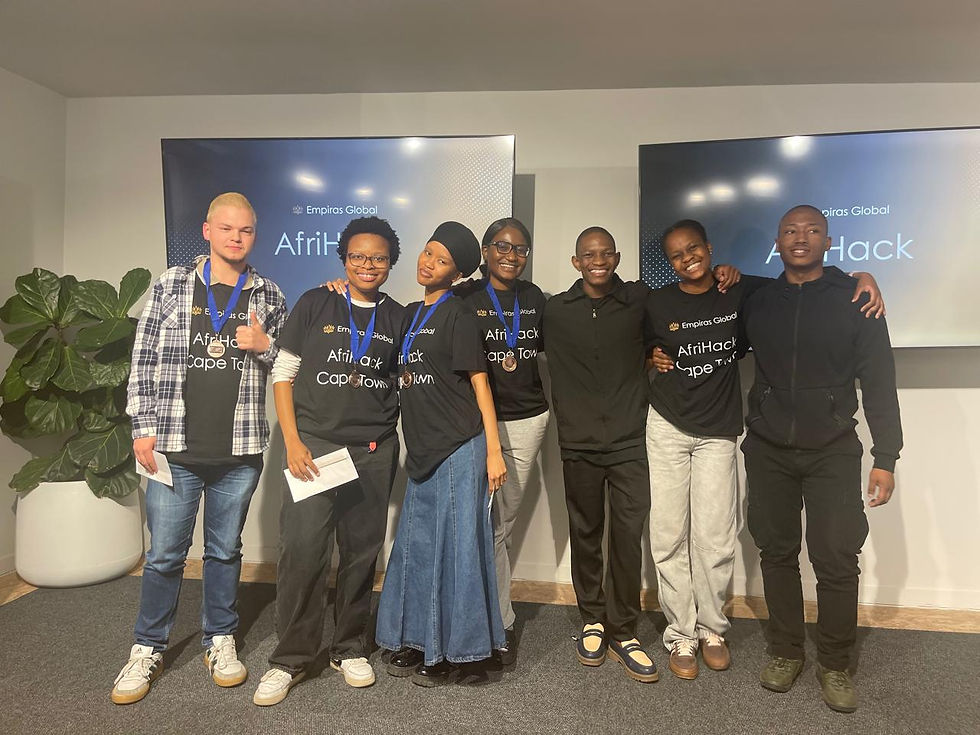

1st Place: 4Site (University of the Western Cape)
2nd Place: FourLoop (CAPACITI)
Joint 3rd Place: Anu (University of Cape Town) & The Co-founders (Cape Peninsula University of Technology)
Cape Town truly surpassed all expectations. When judges can barely tell the top teams apart, the standard of the competition speaks for itself.
But the result that will carry furthest came after the trophies. Gold sponsor 4OnPritchard handpicked several teams from both cities to be incubated and to continue developing their solutions for the organisation. That's the kind of outcome we build AfriHack for. When a weekend of building turns into a real engagement with a real company, you know the model is working.
What Makes AfriHack Different
AfriHack runs on a three-day format for a reason. Day one brings students and industry together. Day two puts students to work building under real pressure. Day three gives them a stage to present what they built to people whose feedback carries weight.
Corporate Day is where relationships start. Panellists take questions, challenge assumptions, and in Johannesburg's case, sit across a table from a 21-year-old TVET student and tell them exactly what their CV is missing. The hackathon that follows gives students a chance to show that the feedback landed. That sequence of listening, building, and presenting is what makes the whole thing work.
Year after year, the solutions get sharper. The presentations get tighter. The gap between "student project" and "market-ready product" shrinks. This year, it nearly disappeared.
Thank You to Our Partners
None of this happens without the organisations that committed time, people, and resources to making AfriHack 2026 real.
The Automotive Industry Transformation Fund and 4OnPritchard were present across both cities as gold sponsors, and 4OnPritchard went further by bringing teams into incubation after the event. GIZ South Africa, through its Digital Skills for Jobs and Income (DS4JI II) programme, supported the participation of TVET college students with transport, meals, and the logistics that make attendance possible for young people who would not otherwise be in the room. That kind of support changes who gets access, and it matters.
Groot Constantia has been part of the AfriHack story since inception. Their continued presence in Cape Town speaks to a partnership built on genuine commitment to youth development. And finally, UVU Africa served as the infrastructure partner for the third consecutive year, providing venue and programme support across both cities.
We are also grateful to all industry partners and exhibitors who came in their own capacities to support AfriHack. And to the Embassy of Japan for opening the door to the MEXT and JET programmes for our participants.
Every one of these organisations chose to show up for young people. That is what makes AfriHack possible, and it is what makes it grow.
What Comes Next
Seven teams placed across both cities. Several are set to be incubated. All of them left with connections, feedback, and visibility they did not have two weeks ago.
AfriHack 2027 is already in planning. We are looking for corporate partners, sponsors, and organisations who want to be part of what's coming next. Whether you want to sponsor, exhibit, judge, or join a panel, this is your invitation to be in the room when South Africa's next generation of tech talent shows what they can build.
The talent is here. The energy is here. And after this year, one thing is clear: AfriHack is only getting started.

About Empiras Global
Empiras Global is a South African education company that identifies, prepares, and places African students in pre-vetted universities worldwide. AfriHack is Empiras Global's flagship hackathon series, bringing together technology students from across South Africa to solve real business problems with technology.
About AfriHack
AfriHack is a national hackathon series hosted by Empiras Global. Each event combines a Corporate Day featuring industry panels, exhibitions, and mock interviews with a 24-hour hackathon where student teams build technology solutions judged by industry professionals. AfriHack has been running since 2024 and operates across multiple South African cities.
For media enquiries, high-resolution images, or interview requests, contact lungile@empirasglobal.com.



Comments